Does magnesium help you sleep? What the research actually found
Short answer: the evidence is thin. The NIH's National Center for Complementary and Integrative Health (NCCIH) says "there is very little research on magnesium supplements for insomnia and other sleep disorders, so there isn't enough rigorous scientific evidence to determine whether they are effective." The reviews we read found small or mixed effects, from studies they rated low or very low quality. Magnesium isn't a proven sleep aid. If poor sleep keeps going, talk to a doctor.
Why so many people ask
Magnesium for sleep is all over social media. NCCIH points to the "sleepy girl mocktail" trend. On Reddit, answers to "does it actually work?" range from "it works for me" to "I didn't notice a benefit." Personal stories can't tell you whether the magnesium helped or something else did, so this page sticks to the studies.
What the reviews found
NCCIH (NIH), "In the News: Magnesium Supplements for Sleep Disorders" (last updated January 2024, opened 30 Oct 2026). It summarizes two reviews:
- A 2021 review of 3 studies (151 participants) "suggested that magnesium may help with sleep-onset latency (how quickly a person falls asleep) in older adults with insomnia," but the reviewers said the studies "were of low quality and inadequate for making well-informed decisions."
- Another review of 9 studies (7,582 participants) "showed conflicting findings," and the authors called for larger, well-designed trials lasting more than 12 weeks.
Mah & Pitre, 2021, BMC Complementary Medicine and Therapies (systematic review and meta-analysis, PubMed 33865376, opened 30 Oct 2026). This is the 2021 review NCCIH describes. Three randomized trials in 151 older adults. In the pooled results, people fell asleep 17.36 minutes sooner on magnesium than on placebo. Total sleep time went up by 16.06 minutes, but that difference was not statistically significant. The authors say all three trials were "at moderate-to-high risk of bias" and the evidence was "low to very low quality." Their conclusion: the literature "is substandard for physicians to make well-informed recommendations." In the same conclusion, they add that because oral magnesium is cheap and widely available, the trial evidence "may support" it for insomnia symptoms. The abstract gives an amount here, which we leave out because this page gives no dosing information. A correction was published in December 2024.
Lopresti, Smith & Drummond, 2026, Journal of Dietary Supplements (systematic review of randomized controlled trials, PubMed 42661485, abstract read 30 Oct 2026). 12 randomized trials in the main analysis. The authors write: "Current evidence does not support oral magnesium as a routine treatment for insomnia. It may provide modest benefits for selected subjective outcomes in some adults, but the findings are inconsistent, and the certainty of the evidence is low or very low." The lead author, Adrian Lopresti, runs Clinical Research Australia, the same contract research company named in the Schuster trial below.
The newest single trial
Schuster et al., 2025, Nature and Science of Sleep (randomized, placebo-controlled, PubMed 40918053, opened 30 Oct 2026). 155 adults who said they slept poorly took magnesium bisglycinate or a placebo for 4 weeks. Insomnia scores dropped more on magnesium (−3.9 vs −2.3 points, p = 0.049). The authors call the effect "small (Cohen's d = 0.2)" and a "modest benefit." Both groups improved. Sleep was self-reported only, with no sleep-lab or wearable data, and the authors say supplementation "alone is unlikely to eliminate insomnia in many individuals." The paper's conflict-of-interest statement says co-author Adrian Lopresti is managing director of Clinical Research Australia, "a contract research organization that receives research funding from nutraceutical companies." He is also the lead author of the 2026 review above.
Side by side
| Source | What was studied | What it found | Evidence quality (authors' rating) |
|---|---|---|---|
| NCCIH (NIH), updated Jan 2024 | Summary of two reviews | "isn't enough rigorous scientific evidence" | n/a |
| Mah & Pitre 2021 | 3 RCTs, 151 older adults | Fell asleep ~17 min sooner; total sleep not significant | Low to very low |
| J Diet Suppl 2026 review | 12 RCTs, adults | Doesn't support routine use for insomnia; mixed findings | Low to very low |
| Schuster et al. 2025 | 1 RCT, 155 adults, 4 weeks | Small drop in insomnia score (d = 0.2) | Self-report only |
"Isn't glycinate the sleep one?"
You'll often read that glycinate is "for sleep." None of the reviews above names one form as the one for sleep. The 2026 review notes that the trials used different "magnesium formulations," which makes it hard to compare forms. What labels can tell you is how much magnesium you get for your money. See glycinate vs citrate and the buffered glycinate label check.
Food comes first
NIH's Office of Dietary Supplements says you can get recommended amounts "by eating a variety of foods," including legumes, nuts, seeds, whole grains and green leafy vegetables. Its food table lists roasted pumpkin seeds at 156 mg per ounce, chia seeds at 111 mg per ounce and boiled spinach at 78 mg per half cup. Magnesium that is naturally in food "is not harmful and does not need to be limited."
Safety: what NIH says
- Upper limit (NIH ODS, credit: Office of Dietary Supplements consumer fact sheet, opened 30 Oct 2026): the upper limit for magnesium from dietary supplements and medications is 350 mg a day for adults and children 9–18. NIH notes this limit doesn't include magnesium in food, and that supplements shouldn't go above it "unless recommended by a health care provider." This is a ceiling, not a suggested amount.
- High intakes from supplements "can cause diarrhea, nausea, and abdominal cramping"; extremely high intakes "can lead to irregular heartbeat and cardiac arrest."
- Magnesium can interact with some medicines, including bisphosphonates, some antibiotics, diuretics and long-term acid-reflux drugs. NIH advises telling your doctor and pharmacist about every supplement you take.
Before you start
We don't give medical advice, and this page doesn't tell you whether to take magnesium or how much. Ongoing sleep problems deserve a proper check with a doctor. Check with your doctor or pharmacist before starting a supplement, especially if you have kidney disease, are pregnant, or take prescription medicines.
We make and sell The Magnesium Decoder, so we earn money if you buy it. This page has no affiliate links.
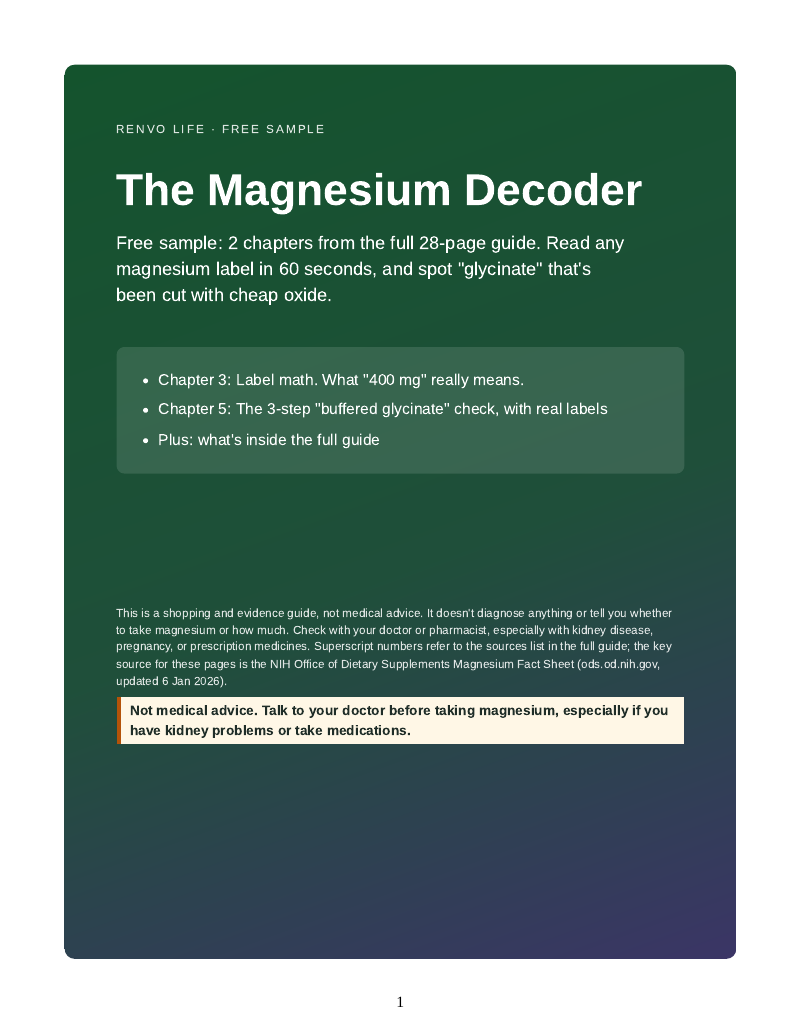
Shopping for magnesium anyway? The Magnesium Decoder ($7) shows how to read any label in 60 seconds, compares the forms on one card each, and ranks 30 products by price per 100 mg of magnesium (brand-store prices, checked 21 Oct 2026). Its evidence chapter covers sleep, anxiety, cramps and more, and names small and industry-funded studies. It's not a dosing plan and doesn't tell you what to take.
How we put this together
We read NCCIH's page, NIH ODS's fact sheets, and the abstracts or full text of the reviews and trial above, and quoted them word for word. We ran no trials of our own. If a source updates, the source wins.
Related: Magnesium glycinate vs citrate · Elemental magnesium label math · Buffered glycinate check · The Magnesium Decoder · Sleep · All guides
Sources
- NCCIH (NIH), In the News: Magnesium Supplements for Sleep Disorders, last updated Jan 2024, nccih.nih.gov (opened 30 Oct 2026)
- NIH Office of Dietary Supplements, Magnesium Fact Sheet for Consumers, ods.od.nih.gov (opened 30 Oct 2026)
- NIH Office of Dietary Supplements, Magnesium Health Professional Fact Sheet (updated 6 Jan 2026), Table 2 food values, ods.od.nih.gov (saved copy 21 Oct 2026)
- Mah J, Pitre T. Oral magnesium supplementation for insomnia in older adults: a Systematic Review & Meta-Analysis. BMC Complement Med Ther. 2021;21:125. PubMed 33865376 · correction (opened 30 Oct 2026)
- Lopresti AL, Smith SJ, Drummond PD. Magnesium Supplementation for Sleep in Adults: A Systematic Review of Randomized Controlled Trials. J Diet Suppl. 2026;23(5):553–581. doi:10.1080/19390211.2026.2719670. PubMed 42661485 (PubMed record and abstract read 30 Oct 2026; full text not read)
- Schuster J, Cycelskij I, Lopresti A, Hahn A. Magnesium Bisglycinate Supplementation in Healthy Adults Reporting Poor Sleep: A Randomized, Placebo-Controlled Trial. Nat Sci Sleep. 2025;17:2027–2040. PubMed 40918053 · doi.org/10.2147/NSS.S524348 (opened 30 Oct 2026)
Not medical advice. This page reports what NIH and the studies above say. Ask your doctor or pharmacist about your own health.
Free PDF guide: Biohacking on a budget
We may earn a commission from links on this page. How we make money
Last updated 30 Oct 2026