Best chiller for a stock tank cold plunge
Most stock tanks people use as plunges hold somewhere between 90 and 200 gallons, so look at a 1 HP chiller first. Plunge Chill lists its 1HP for up to 200 gallons in its comparison table, and its spec list says it cools up to 110 gallons from 80°F to 40°F in about 8 hours. It includes a submersible pump, so you don't have to drill the tank. If your tank holds 66 gallons or less, a 1/3 HP unit is enough. If you want a US-made chiller for an indoor setup, Penguin Chillers' 1/2 HP is built in Tennessee.
Check your tank's capacity on its maker's listing, and count the water to about the height you'll sit at, not to the brim.
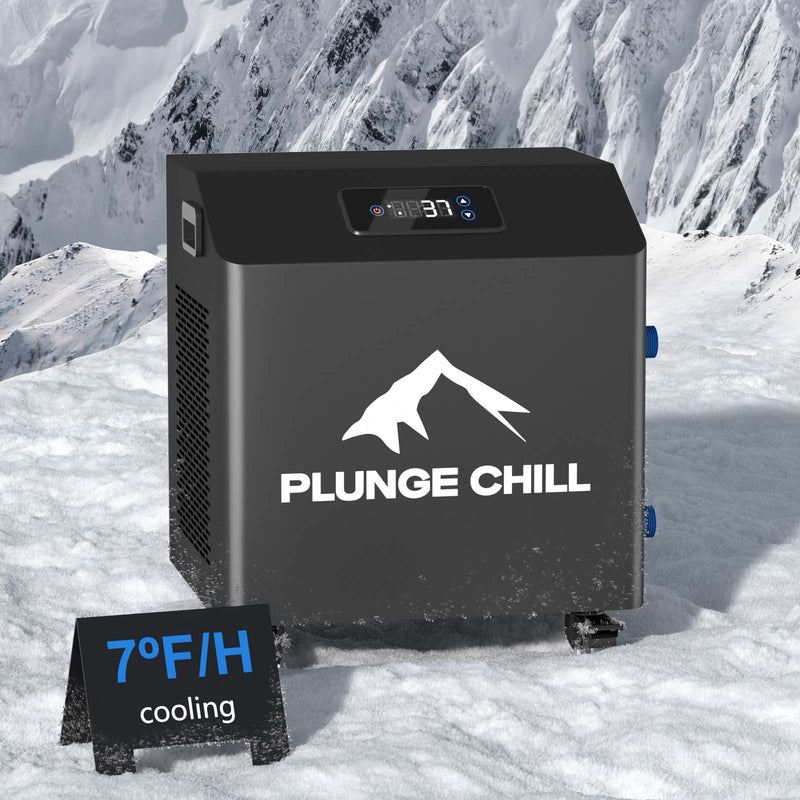
We earn a commission if you buy through our links.
Plunge Chill 1HP at Plunge Chill Anzeige · affiliate link
The chillers, on the makers' specs
| Maker spec (29 Oct 2026) | Plunge Chill 1HP | Plunge Chill Tub with Chiller (1/3 HP) | Penguin Chillers 1/2 HP |
|---|---|---|---|
| Lowest temp (each maker's figure for its own unit) | 36°F (Plunge Chill) | 39°F (Plunge Chill product pages; the comparison table on its 1HP page lists 42°F) | 37°F (Penguin's operating range is 37°F to 100°F with water) |
| Rated volume | Up to 200 gal in Plunge Chill's comparison table. Its spec list says up to 110 gal from 80°F to 40°F in about 8 hours | Up to 66 gal (the tub in the bundle holds 92 gal) | Listed as 5,000 BTU/hr, not in gallons |
| Cooling | 2,700 W cooling capacity on the Plunge Chill FAQ (this is cooling, not power draw). 110 gal from 80°F to 40°F in about 8 hours, about 5°F an hour | 600 W. 66 gal from 75°F to 50°F in 8 to 10 hours | 5,000 BTU/hr, 450 W draw |
| Pump and filter | Submersible pump and 20-micron inline filter included | Built-in pump and mesh filter | You choose the pump. Penguin recommends a Danner Mag Drive 5.0 to 18 |
| Where it goes | Indoor and outdoor, ambient 0 to 95°F | Indoor and outdoor | Indoor. Penguin also lists an outdoor-rated 1/2 HP HE model |
| Size and weight | 16.5 × 13.8 × 18.9 in, 73 lb, on casters | 14.9 × 11.8 × 12.6 in, 35 lb | 16.25 × 14.75 × 12 in, 39 lb |
| Warranty | 2 years, 30-day returns | 2 years, 30-day returns | 1 year |
| Connections | Insulated hoses and install kit | ½ in ports on the tub | 1 in female NPT |
Why stock tank owners look at a 1HP
Stock tanks usually hold more water than inflatable tubs, and most of them sit outdoors. Plunge Chill lists its 1HP for up to 200 gallons (comparison table) or 110 gallons from 80°F to 40°F in about 8 hours (spec list), and for ambient temperatures up to 95°F, and it ships with a submersible pump. That pump is the part that matters for a stock tank: the tank has no ports, and Plunge Chill says the pump and hose setup is how you connect a tub without them. Plunge Chill also asks for at least 10 inches of clearance around the unit, and about 12 inches is ideal, for airflow.
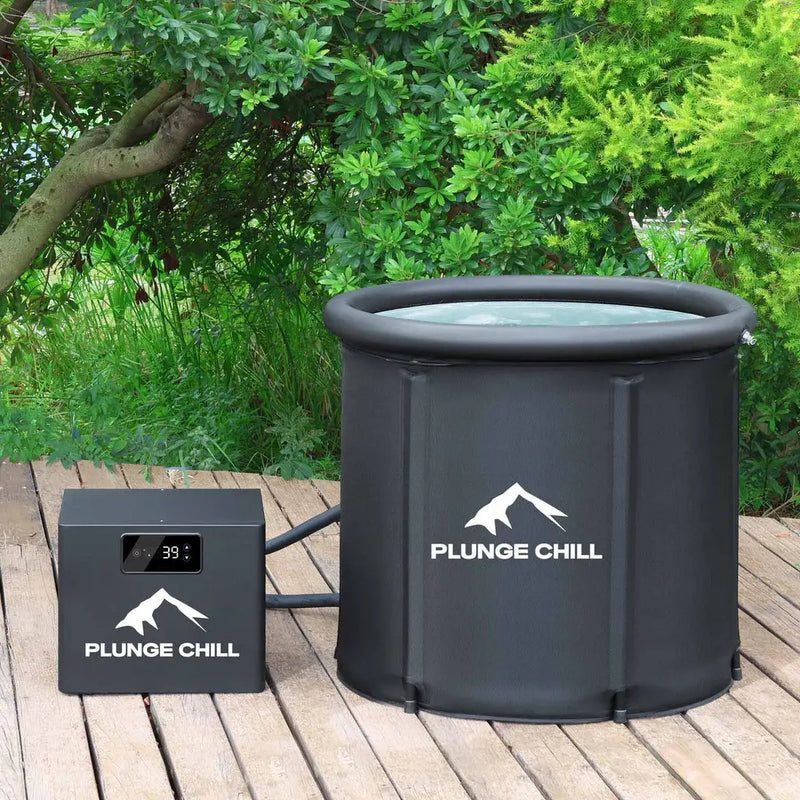
Plunge Chill Tub with Chiller at Plunge Chill Anzeige · affiliate link
Penguin 1/2 HP at Penguin Chillers Official product page · no commission
Running cost, in plain numbers
- First cool-down on the 1HP: Plunge Chill lists about 4.25 kWh to take water from 90°F to about 39°F. At the US average home rate of 18.16¢ per kWh (EIA, August 2026 data, released 23 Oct 2026), that is about 77¢ of power.
- Holding temperature on the 1/3 HP bundle: Plunge Chill lists 3 to 6 kWh a day. At 18.16¢ that is about $16 to $33 a month.
- Penguin 1/2 HP: Penguin lists a 450 W draw. What it costs you a month depends on how many hours it runs each day, which comes down to your climate, your lid and your tank. A plug-in watt meter shows your own number.
Those lines use the makers' figures and one national electricity rate. The Cold Plunge Running-Cost Planner ($7) redoes ice against a chiller with your power bill and your ice price, and it includes a water-change log.
Hours and your own rate go in the cold plunge running cost calculator.
Setup checklist for a stock tank
- Work out your water volume and compare it with the chiller's rated gallons.
- Use a lid. Plunge Chill's own cooling figures for the 1/3 HP assume a covered tub.
- Leave about 10 to 12 inches of clearance around the chiller.
- Sort out the pump. Plunge Chill includes one. With Penguin you pick your own, rated under 10 PSI and 23 ft of head, per Penguin.
- Plan for filter changes. Both Plunge Chill units come with a filter.
For a wider comparison, see the cold plunge chiller comparison, the Plunge Chill Pro Tub specs and our cold plunge gift guide. Sale dates for these chillers are on the Black Friday 2026 recovery deals page.
What the research says about cold water
Research on cold-water immersion hasn't settled on an ideal temperature or schedule, and the review authors call for more and longer studies. Cain et al., 2025 · Espeland et al., 2022
If you have a heart condition or another health concern, ask your doctor before you start cold plunging.
FAQ
What size chiller do I need for a stock tank?
Match the chiller to your gallons. Plunge Chill lists its 1/3 HP unit for up to 66 gallons. For its 1HP it gives two figures: up to 200 gallons in its comparison table, and up to 110 gallons from 80°F to 40°F in about 8 hours in its spec list. It also says a 1 HP chiller is typically recommended for 90 to 150 gallon tubs.
Can I use a chiller with a stock tank that has no ports?
Yes, with a submersible pump. Plunge Chill includes one with its 1HP and says it is there for tubs without built-in ports, so you don't have to drill.
How cold can a cold plunge chiller get?
Each maker gives its own figure for its own chiller. Plunge Chill says its 1HP goes as low as 36°F and its 1/3 HP as low as 39°F. Penguin Chillers lists an operating range of 37°F to 100°F with water for its 1/2 HP.
How much electricity does a cold plunge chiller use?
Plunge Chill lists about 4.25 kWh for a 1HP cool-down from 90°F to about 39°F, and 3 to 6 kWh a day to hold temperature on its 1/3 HP tub bundle. Penguin lists a 450 W draw for its 1/2 HP while it runs.
What temperature can these chillers reach?
Plunge Chill lists 36°F for the 1HP and 39°F for the 1/3 HP. Penguin lists 37°F for the 1/2 HP. Those are each maker's figure for its own unit.
How do I price the electricity for a stock tank chiller?
Type the watts, the hours and your rate into the cold plunge running cost calculator.
How we compared
We took every spec from each maker's own product page on 29 Oct 2026: temperature, rated volume, cooling figures, power, pump, size and warranty. Cooling times and energy use are the makers' figures and depend on room temperature, insulation and water volume. The electricity rate is the EIA's US average residential price for August 2026. If a maker changes its page, the page wins.
Sources
- Plunge Chill 1HP (Anzeige · affiliate link) · Plunge Chill Tub with Chiller (Anzeige · affiliate link) · Penguin Chillers 1/2 HP · opened 29 Oct 2026
- EIA Electric Power Monthly, Table 5.6.A, August 2026 data, released 23 Oct 2026, opened 29 Oct 2026
- Cain et al., 2025, PLOS One · Espeland et al., 2022
Free PDF guide: Biohacking on a budget
Last updated 31 Oct 2026